Mind your psychic fuel gauge
For much of my early career, I focused more on career advancement and long term goals than on how I felt about what I was doing every day, and nearly burned myself out in the process.
This caused me to rethink what it means to build a career that's sustainable, and what opportunities I have to balance purpose and meaning with finding joy in the daily work itself.
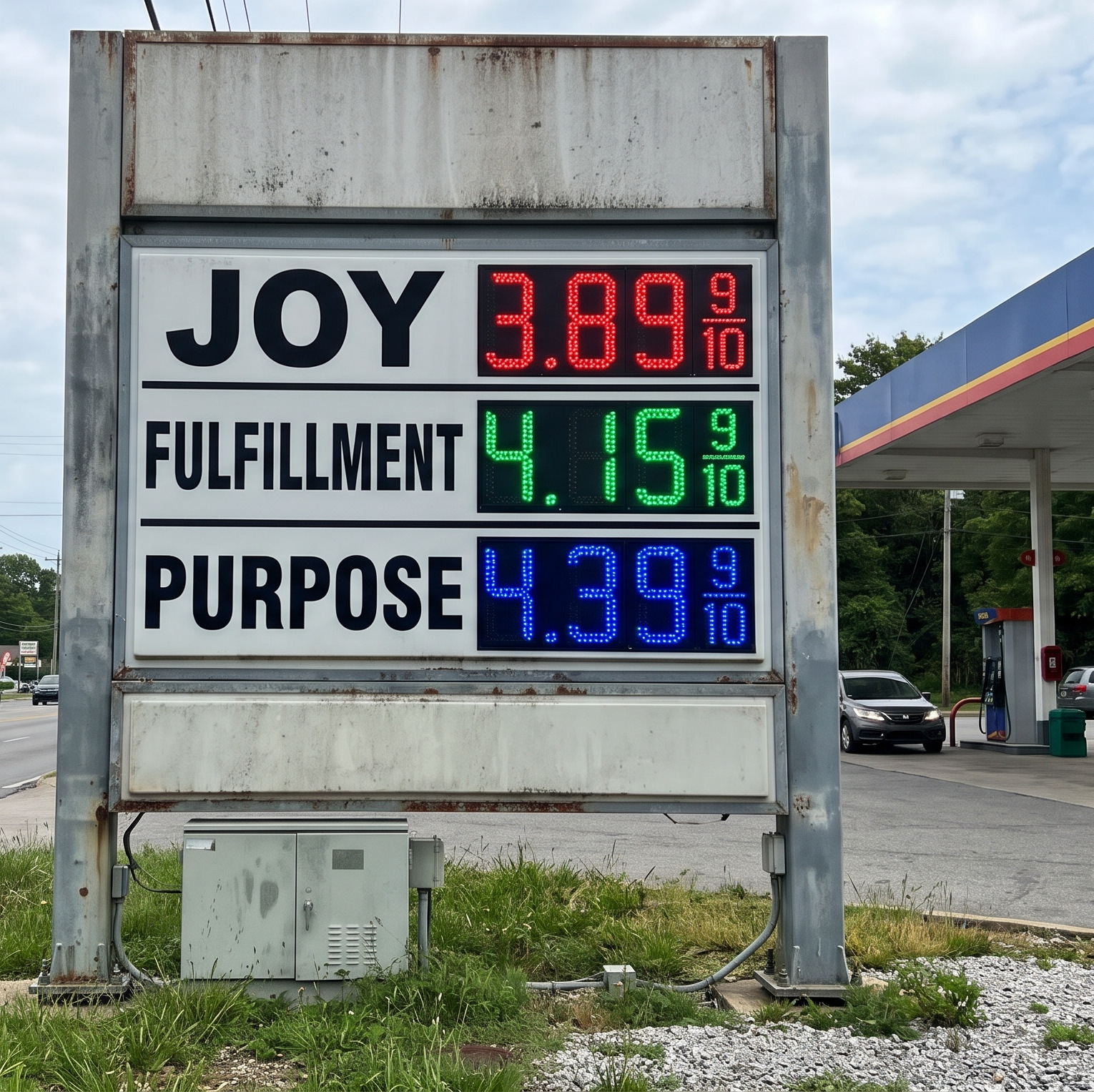
One of the more surprisingly important abilities I've acquired over the years: an acute awareness of my own psychic fuel gauge. After all these years, I feel like I've finally got a pretty good handle on what things feed my creativity, give me energy and momentum, and what things slowly drain me- sapping my resilience and leaving me feeling spent.
For instance, I know that days I spend building stuff with my team, exploring problem spaces, doing research, running experiments, and getting new features released to customers- these are the kind of days that get me excited to get out of bed and get to work.
Other things weren't so obvious to me, initially. I now know that time spent on people and organizational issues tends to drain my battery. It costs me a slow trickle of energy to get through routine, everyday ceremonies, one-on-ones, and administrivia. Calendar fragmentation takes a toll; especially when dominated by meetings that feel like cognitive speed bumps- tangential to what I had my heart set on accomplishing that day.
Dealing with the negative aspects of human relationships takes a lot more energy. Difficult conversations, addressing poor performance, dealing with history, mistrust, and thorny unspoken grudges- it's really important to surface and tackle these deliberately, but man, this is when I really feel my CPU fan come on.
It's a bit ironic, because I think I've become fairly decent at this stuff, and I know it's important work. I even volunteer to help with these kinds of problems sometimes, especially when I think I'm well positioned to be useful. This unfortunately doesn't change what it does to my body.
Getting dangerously close to burnout

About a decade ago, after years of operating primarily as a player-coach for small teams, I allowed myself to be drafted into a director position where I was helping run a bunch of teams, full-time. Admittedly, a lot of the work was stuff I love: product and architectural strategy, building alignment around a vision, and driving delivery.
Maybe in an ideal organization, that would have been the bulk of the way I spent my time- but it just wasn't in my case. In practice, most of my days were spent doing exactly the kinds of things that I now recognize as more depleting than replenishing.
After 3 years of this, I got dangerously close to burning out. I didn't quite understand what was happening, because I was in exactly the kind of position I had been working towards for my whole career. I was enjoying having a broad impact, and more organizational influence than I'd ever had before.
For the first time in my adult life, I stopped looking forward to going to work. I felt perpetually shitty in a way I'd never felt before, and it wasn't going away.
In a lucky coincidence, I had dinner with an old colleague around this time, who offered me a new job in a new industry. His offer put into concrete terms something I hadn't yet come to grips with, and helped me see my own situation more objectively. I was so caught up in the idea of what my job meant, but I had lost sight of how it felt to do my job every day.
I ended up taking the new job, which I was able to structure around the things I really wanted to work on. I started to feel better almost immediately, and I realized shortly thereafter how close I had come to running myself completely into the ground.
Be honest with yourself about your priorities
Since then, it's been pretty clear to me that while I do enjoy being well paid, I've hit an inflection point where more money isn't going to make my life meaningfully better. I'd so much rather steer my career such that I can spend my time doing the things that get me excited and engaged.
Admittedly, this is a super privileged position to be in. For some of my friends, especially first or second generation immigrants, the pressure to succeed is a whole different kind of burden. The opinions of their families or communities about what their careers should be is a very strong force, and can make them feel like they're being selfish for focusing on what they want out of work.
Many folks I've known in this situation have found some sort of equilibrium that worked well enough for them. Some figured out how to have the best of both worlds- building their careers around their passions- which also led to economic success.
I've got one friend who was raised by a single mom, and focused his career on making enough money so he could buy her a nice house and retire. Respect.
Even for those without family/cultural/economic pressures, there's a ton of other dimensions involved: risk tolerance, social concerns, political views, work/life balance, geography, health/safety, etc.
For me: there's a few industries I'd never work in, even if I was offered an amazing, exciting job that met all my other criteria. I'm not trying to sell a one-size-fits-all rubric here.
That said: I think there's something deep and universal about the nature of our relationship to work. We spend a huge portion of our lives doing it, and given the opportunity- we want it to not suck. It's very hard to flourish in one's life overall without meaningful, engaging work.
Not an airport bookstore
Fair warning: we're dipping into self-help territory here, but I've had enough career coaching conversations to know that this stuff isn't as cliche or obvious as people think- especially to people who are early in their careers, and don't yet feel a lot of agency.
If you've decided, like me, that you want to optimize your career for fulfillment and happiness, my advice is to reflect deeply about what you want in two dimensions: Purpose and Joy.
Purpose gives you direction
Purpose is about deeply held beliefs, desires, or goals that motivate you in the long term.
This might be about promoting justice, improving the lives of others, creating beautiful things, discovery and exploration, or striving for excellence in some endeavor. For lots of people, it can be as straightforward as providing some product or service that makes their customers happy.
Purpose sets us to do things that are hard: things that require grinding, boring, painful, or frustrating work. Difficulty and struggle are a big part of what makes accomplishments meaningful.
The accomplishments I'm most proud of in my career required me to spend lots of time doing exactly the things I told you I find draining. Anticipation of those achievements was a big motivator, but for me, it wasn't enough to be sustainable.
Joy gives you sustainability
For me to maintain sustainability, I know I need to spend a significant amount of my time on things that bring me joy and satisfaction on a daily timescale, even when I'm working towards longer-term goals. I can push through days or weeks of toil if my target is sufficiently enticing, but trying to push through months or years is what nearly burned me out.
My advice to young people is to step back and reflect on what you want in your daily life in concrete, tangible terms, separately from your sense of purpose. Think back over the last week: what specific activities you felt excited about, which small milestones really mattered to you, what kind of people you enjoyed being around.
But be honest with yourself. If you find yourself consistently procrastinating or avoiding particular tasks, or that you're consistently fried afterwards... that's your body telling you that you might not want to take your career in a direction where you'll be doing more of those things.
It's all about finding a balance that keeps your fuel tank filled. Just keep an eye on the gauge.