Oops, this app I vibe-coded is load-bearing
The current generation of AI coding tools have given rise to a notion: non-technical users can now build real, production software- without a background in software engineering.
While technically true in the narrowest sense, I'm seeing examples of this idea being dramatically overstated- in a way that reveals some pretty profound misconceptions about the discipline of software engineering- and a surprising disregard for expertise more generally.
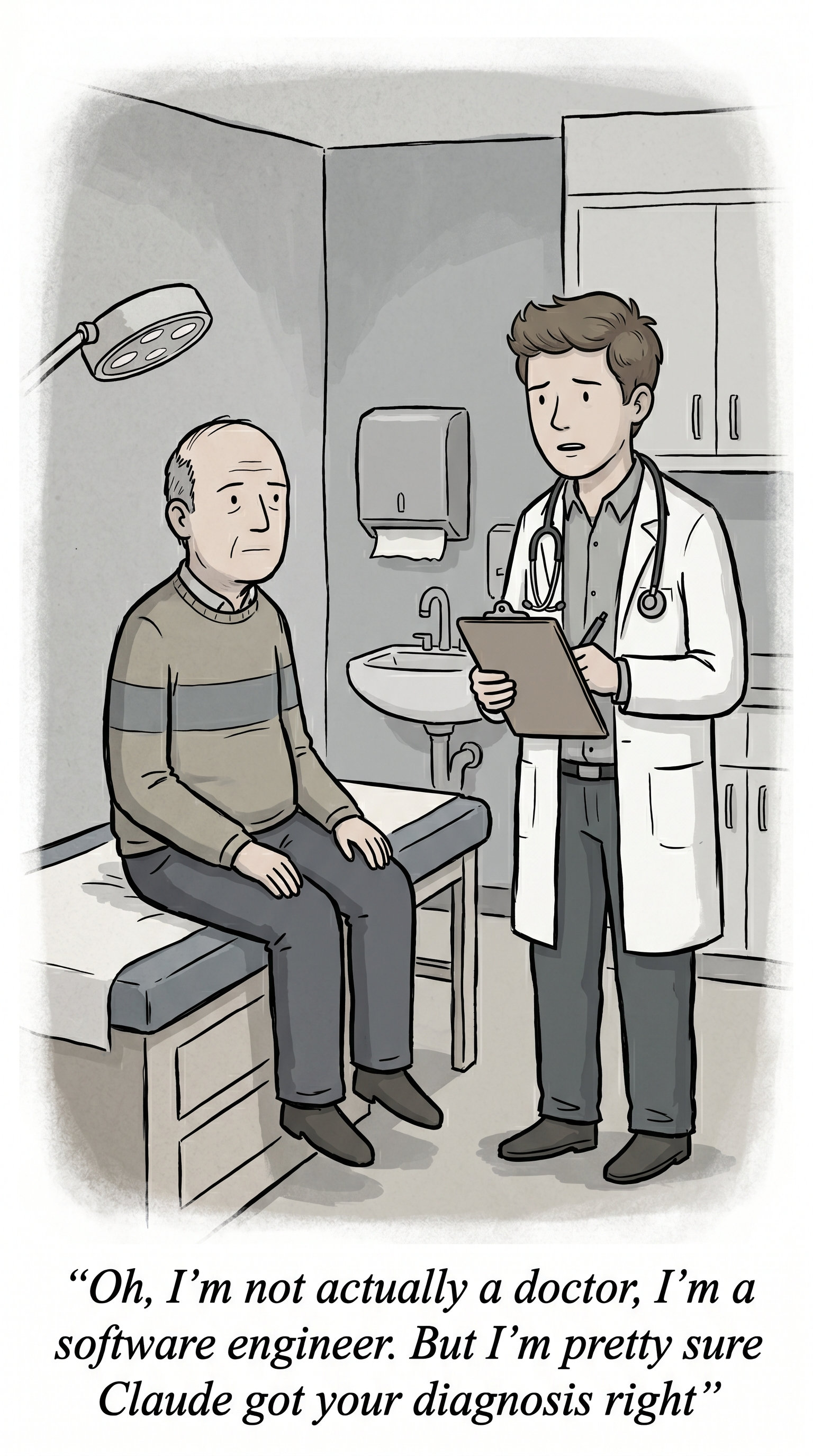
My company, like many others, is exploring what it means to empower non-technical employees with AI coding tools. There's a pervasive narrative that these tools make coding a "solved problem"- giving anyone the ability to vibe up real, working, useful software systems.
Until recently I've really tried to be open-minded about this idea, but after being involved in some recent, real-life experiments- and applying a little additional scrutiny, this fantasy falls apart rapidly.
I could be CMO, right?
I recently had a dream where my company's president told me that now that I've had such great success using Claude to solve engineering problems, he wanted me to take over our go-to-market function- bringing the same kind of wins I've had there.
Unlike most dreams, this one stuck with me. I found myself dwelling on it; the cleverness of my subconscious's little thought experiment became more apparent, even as it seemed increasingly, comically, absurd.
To be clear: I have basically zero expertise in go-to-market. I've spent my career in engineering- the last 10 years in "platform engineering" (working on backing infrastructure)- which is one more step removed from customers than most engineers.
In my career, I've had the fortune to be able to rely on very, very smart colleagues who've dedicated themselves to the craft of marketing. From them, I've developed a rough working understanding of brand strategy. I've done some technical work to support campaigns and attribution, and I've also supported teams doing customer analytics. I've read market research reports and mostly understood them.
In other words, I know enough to know just how little I know. I'm a marketing kindergartner.
So the idea that I'd use Claude to take over Marketing seems obviously insane. No executive in their right mind would assume that AI would turn a random engineer into a competent marketer. Giving me an advertising budget would be blatant negligence.
Don't get me wrong, I'm down to take on any challenge. I've learned to use AI to build marginal competence in unfamiliar technical domains- and this has worked out pretty well for me.
I'd probably start by using it as an educational tool- give myself a mini-MBA. I'd focus on developing high-level concepts and vocabulary, and gradually build a mental model I can use to slowly test my understanding with some small experiments.
Now that I think about it, maybe it's not such a bad idea. Surely marketing can't be that hard. What could go wrong?
There's a reason they give degrees for this shit
This led me to begin thinking more deeply about what it would mean for non-technical vibe-coders to jump into my world- and start producing software... and this is the important part... that the business depends on.
I think a lot of non-engineers hold the understandable misconception that "writing code" and "software engineering" are basically synonymous. Please bear with me while I disabuse you of this notion.
Let's imagine a non-technical user has vibe-coded up a working full-stack application (web frontend, backend server, and a database). I'll lay out a few examples of the kind of stuff they're going to have to learn about, just to manage and operate this one application:
- Design and architecture: Experienced engineers have learned to choose among well-understood patterns, with known tradeoffs, to build systems with attributes that work for their intended purpose. There's a whole set of language and concepts that will be completely foreign to a non-technical vibe-coder (e.g. consistency models, sharding, algorithmic complexity, client/server, idempotency, etc). This isn't just jargon; these are real concepts from computer science that are integral to making real systems work. The more the scope of your app grows (especially in terms of its importance to the business), the more critical this stuff becomes.
- Debugging, diagnosis, and troubleshooting: This includes being able to debug the code itself, but also all dependencies that got pulled in, the platform/cloud/infrastructure it's running on, interactions/relationships with other systems. Fun fact: when engineers are "coding", the bulk of what they're really doing is debugging.
- Observability: This is how we understand how our systems are actually behaving in production, and a critical part of how we identify and troubleshoot problems. There are different types of telemetry "signals" for different purposes, all kinds of analysis tooling and query languages, visualization techniques, and tooling to set up alerts that will page you when things go off the rails.
- Database administration: Most useful software has to maintain "state" somewhere- this is often a database. With databases, you've got to have a strategy to manage schema updates (without production impact), identify and optimize slow queries, administer database upgrades- and a whole mess of "DBA-lite" skills full-stack developers need.
- Risk management and testing: How do you know if your code is going to behave correctly when you add a new feature? How do you know your change didn't break existing features? Experienced engineers use methodologies like "Test Driven Development", API contracts, property-based testing, fuzzing, etc- and design their code to make it amenable to such techniques.
- Maintenance: Engineers spend an embarrassing amount of time staving off "code-rot". As time passes, APIs your app depends on get schema updates (or get deprecated/retired), security vulnerabilities get discovered in libraries you depend on, infrastructure changes out from under you. Unfortunately, code doesn't keep working without TLC.
- Security: Decisions made by engineers at all levels (e.g. from big architectural decisions to tiny coding choices) have security impact. Decisions about security have all kinds of inherent tradeoffs and consequences. We spend years developing instincts about how to avoid our apps getting pwned. Mistakes can be catastrophic.
- Being on-call: If your app is load-bearing to the business, you'll need to set up your on-call rotation, so you get woken up in the middle of the night when a slow-burning memory leak causes your app to get OOM killed. Oh, and you have to learn what "OOM killed" means.
I could go on and on, but I promised myself I'd try to keep this post short. I could rattle off another 30 bullets, easily. Suffice to say, each of the ones above could be expanded into a career's worth of learning.
A mountain of trivia
I suspect this is the case in other fields, but whenever I onboard a new college graduate to an engineering team, I'm struck with self-awareness of the absolute mountain of trivia that's required to be effective in our field.
Modern software is built on a gigantic ecosystem of open-source tools and libraries, all of which encapsulate a huge amount of accumulated complexity- each with their own quirks and sharp edges. They all have cute names that you just have to memorize, and have them mapped to a set of related concepts, jargon, and tools, and know to what problem spaces they apply. This is the stuff that fills up like 80% of my brain.
This all may seem nuts to someone outside our field, but the bulk of this isn't "accidental" accumulated complexity. Some of it has historical origins, but much of it is a reflection of complexity that exists in the real world. After all, software is all about modeling real-world concepts, and finding ways to do useful work that humans benefit from.
Organizational complexity limits
Another side-effect for organizations that encourage non-technical employees to write software- they're going to increase the overall net complexity their organization has to absorb and carry.
Code is often thought of as an asset, but it's important to understand that it is also a liability. Its value is that it can automate processes, and be adapted over time as those processes inevitably change. All this requires humans to understand it (at least at a high-level), and to be able to reason about how it works, how it could be changed, and how it could fail.
Organizations are made up of a finite number of humans, and these humans have a limit to the space available in their collective brains to absorb this complexity. More of them writing software means more of that space is being used up- leaving less room for the software that is most critical. This is made worse by the fact that these net-new software authors have no experience in maintaining or operating software.
It seems, so far, like AI tools- when used effectively- can reduce the burden of maintaining individual systems over a long horizon. This could, in turn, increase the total complexity an organization could absorb.
In my experience, however, this requires very careful attention. The code authors need to apply thoughtful design, maintain comprehensive documentation, and apply a lot of discipline to ensure that a repo is optimized to allow agents to work well with them.
None of what's required to make this work is particularly obvious, and I'm skeptical that it's something that would emerge naturally among non-technical vibe-coders.
Can't AI handle this stuff for me?
I mean, it can certainly help with parts, and it will almost certainly expand in capabilities into the future.
But today: if you don't already have significant experience with design, debugging, and operations- odds are you're going to be in over your head in short order.
I'm personally experiencing an enormous boost of productivity and creativity from using AI agents on engineering problems- but I've got almost 30 years of experience writing software without AI. I have instincts that come from years of hard-won experience. I can tell when agents are giving me bad output, and I can adjust accordingly because I already know what good looks like. A non-programmer isn't going to be able to recognize when they've gotten slop.
AI agents are extraordinarily good at researching, synthesizing, and reasoning within a relatively small context. They're not very good at strategizing, seeing the big picture, or understanding the current task in the context of a longer-term goal.
The value, for me as an engineer, comes in combining my skills and experience with this superhuman speed within a series of bounded tasks where I'm keeping control of the big picture.
A non-technical user will be able to build some interesting things with agentic tools, but you probably don't want them building software that runs accounting systems, medical devices, or aircraft control systems. You probably also don't want them building software that runs your business.
What should non-technical people do with AI coding agents?
All this said, I think AI coding agents can provide real, meaningful value for non-technical folks.
First off, I'm really not trying to gatekeep. It's awesome that these tools will empower more people to explore and learn more about software. This democratization will undoubtedly drive a surge of creativity and innovation, as well as help build more empathy and understanding between engineers and their non-technical colleagues.
For non-technical teams, I think the best play with AI coding tools is to use them to rapidly build prototypes that test hypotheses, prove out business opportunities, and demonstrate value- ahead of major investment. Armed with their domain expertise, non-technical folks can probably do a whole lot of exploration of a problem space, and converge on really substantial, well-vetted ideas.
One great place for non-technical teams to start: automate processes that you wouldn't have been able to previously, especially for processes where the value of the opportunity wasn't clear enough to justify engineering resources. Once the value of the automation becomes more apparent, and you identify a need for more reliability or efficiency, you could seek engineering resources to help build a more mature version.
I think the real value will come from a combination of empowered business and domain experts working in collaboration with software engineers that are themselves massively accelerated with AI. I think this is the sweet spot.
Consider the nature of your own skills and experience
We're already hearing stories about 3-person startups that launch vibe-coded products in insanely short timelines, and hitting revenue targets that would have previously required a decent-sized engineering team. This makes a lot of sense in the early stages of a startup, where robustness and reliability are often secondary to finding product-market fit.
I'm certain there are a number of executives in mid-sized and large companies hearing stories like this, and it's making them think they're going to be able to bypass the traditional prioritization constraints that prevent them from getting a swath of software projects delivered. After all, their product team can just vibe-code any software they need.
If this accurately describes your current perspective, I'd recommend taking a quick beat and considering whether you think it's equally plausible that one of your engineers could use Claude to take over your role.
My guess is that would sound pretty silly.